Where do Greek Americans live today?
Using data from the U.S. Census Bureau’s American Community Survey (ACS) 2020–2024 5-year estimates, this post identifies the top 20 places with the largest numbers of residents reporting Greek ancestry in the United States.
While New York City, Chicago, and Los Angeles remain the largest Greek-American communities, the list also includes several cities in the South and West. Several of these communities also increased in size between 2010 and 2024, suggesting that the geography of Greek America continues to change.
A previous post examined how the geographic distribution of Greek Americans has changed across the United States since 1980. This post takes a closer look at the local level by identifying the 20 communities with the largest numbers of residents reporting Greek ancestry in 2024.
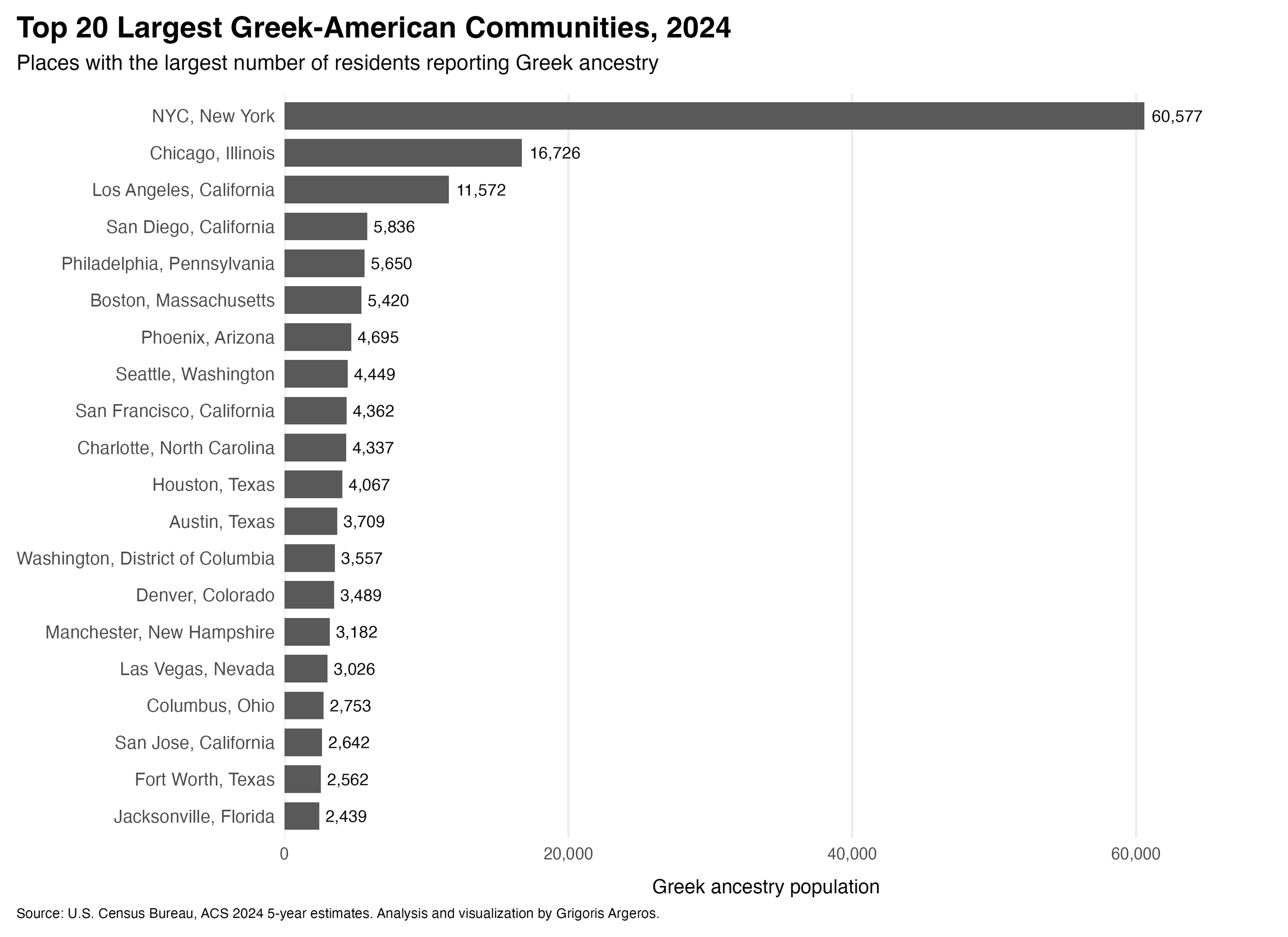
Figure 1. Top 20 largest Greek-American communities in the United States in 2024, based on residents reporting Greek ancestry in the U.S. Census Bureau’s American Community Survey. New York City remains the nation’s largest Greek-American community, followed by Chicago and Los Angeles.
Figure 1 shows the twenty places with the largest Greek ancestry populations in 2024.
New York City remains by far the nation’s largest Greek-American community, with an estimated 60,577 residents reporting Greek ancestry. Chicago ranks second with 16,726 residents, followed by Los Angeles with 11,572. Together, these three cities continue to be among the most important centers of Greek-American settlement in the United States.
The rankings also highlight the geographic diversity of contemporary Greek America. In addition to long-established communities in the Northeast and Midwest, several cities in the South and West appear among the nation’s largest Greek-American communities, including Phoenix, Houston, Austin, Denver, Las Vegas, and Fort Worth. This distribution highlights the broad geographic reach of contemporary Greek America and suggests that large Greek-American communities are no longer confined to a small number of traditional destinations.
While Figure 1 provides a snapshot of the largest Greek-American communities today, Table 1 compares these same communities with ACS estimates from 2010, allowing us to examine how their populations have changed over time.
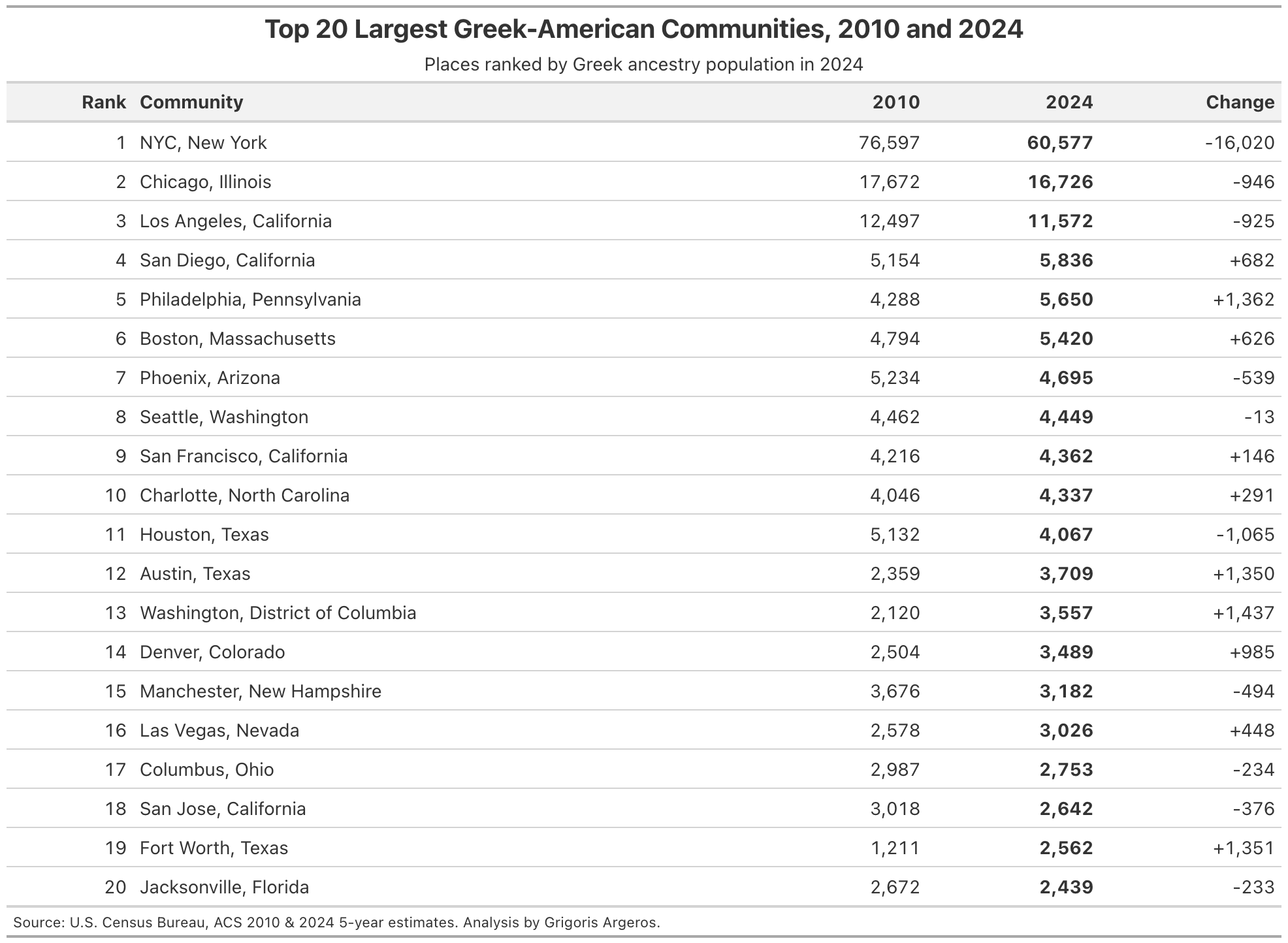
Table 1. Table 1. Top 20 largest Greek-American communities in the United States, 2010 and 2024. Communities are ranked by the number of residents reporting Greek ancestry in 2024. The table also reports estimated Greek ancestry populations in 2010 and the numeric change between 2010 and 2024.
Several communities experienced declines between 2010 and 2024. Although New York City remained the largest Greek-American community in the country, the estimated number of residents reporting Greek ancestry declined from 76,597 in 2010 to 60,577 in 2024, a decrease of 16,020 (21%). Smaller declines were also observed in Chicago, Los Angeles, Houston, Phoenix, Manchester, Columbus, San Jose, and Jacksonville.
At the same time, several communities recorded gains. Washington, DC, experienced the largest numeric increase among the top twenty communities, growing from 2,120 residents reporting Greek ancestry in 2010 to 3,557 in 2024 (+1,437). Philadelphia (+1,362), Fort Worth (+1,351), Austin (+1,350), and Denver (+985) also registered notable increases during the period.
Overall, the results reveal both continuity and change within Greek America.
Traditional centers such as New York City, Chicago, Los Angeles, Boston, and Philadelphia continue to contain some of the nation's largest Greek-American populations.
At the same time, several communities in the South and West grew in size between 2010 and 2024, while others declined.
Together, these patterns suggest that changes in the distribution of the Greek-American population have not occurred uniformly across communities.