A previous post, Where Do Greek Americans Live? Population Shifts Since 1980 (https://www.greekamericabythenumbers.com/posts/where-do-greek-americans-live-population-shifts-since-1980) examined where Greek Americans live and how the number of residents reporting Greek ancestry in the nation’s largest Greek-American communities has changed since 1980. This post takes a different approach by focusing on concentration rather than population size.
Using data from the 2024 5-year estimates of the American Community Survey (ACS), this analysis identifies the top 20 places where residents reporting Greek ancestry make up the highest percentage of the local population. To avoid rankings being affected by very small Greek ancestry populations, the analysis is limited to places with at least 500 residents reporting Greek ancestry in 2024. The threshold was based on the size of the Greek ancestry population because the goal was to identify communities with a notable Greek-American presence, rather than places that exceeded a specific total population threshold.
While large Greek-American communities such as those in New York City, Chicago, and Los Angeles contain the largest numbers of residents reporting Greek ancestry, they do not necessarily have the highest concentrations of Greek Americans. Measuring Greek Americans as a percentage of a place’s total population provides a different perspective on the geography of Greek America.
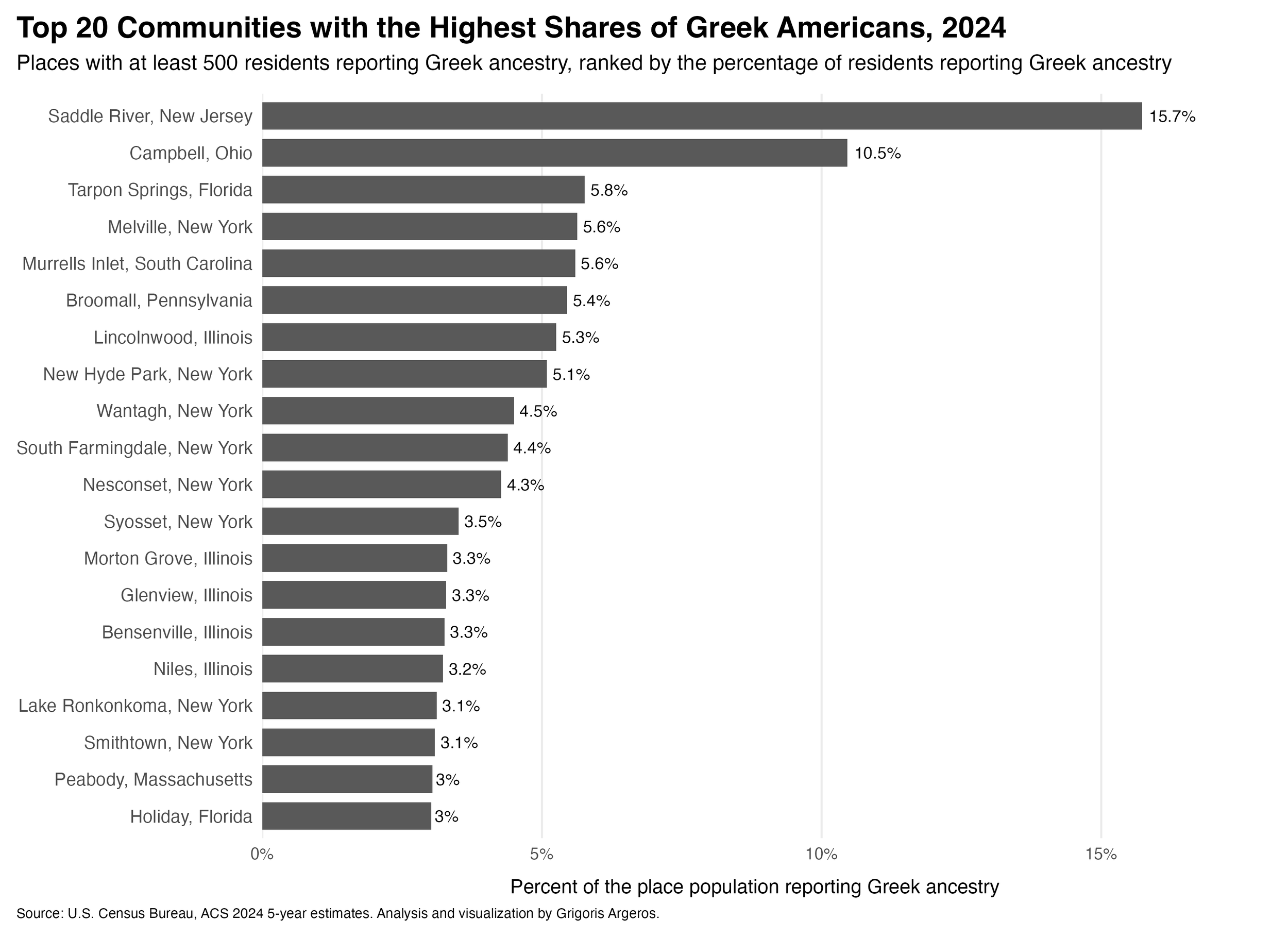
Figure 1: Bar chart showing the top 20 U.S. communities with the highest shares of residents reporting Greek ancestry in 2024. Saddle River, New Jersey, ranks first (15.7%), followed by Campbell, Ohio (10.5%) and Tarpon Springs, Florida (5.8%).
Figure 1 shows the twenty communities with the highest percentages of residents reporting Greek ancestry in 2024. Saddle River, New Jersey, ranked first, with 15.7% of residents reporting Greek ancestry. Campbell, Ohio, ranked second at 10.5%, while Tarpon Springs, Florida, ranked third at 5.8%.
The results also highlight the geographic diversity of contemporary Greek America. The ranking includes places in the Northeast, Midwest, and South, including several communities on Long Island, suburbs outside Chicago, and well-known Greek-American centers such as Tarpon Springs. Long Island is particularly well represented, accounting for eight of the twenty highest-ranked communities. In other words, 40% of the top 20 places are located on Long Island.
The figure also shows the difference between population size and concentration. Although New York City remains the nation's largest Greek-American community by population size, residents reporting Greek ancestry account for less than 1% of the city's total population. However, several smaller communities rank highly because residents reporting Greek ancestry comprise a much larger share of the local population.
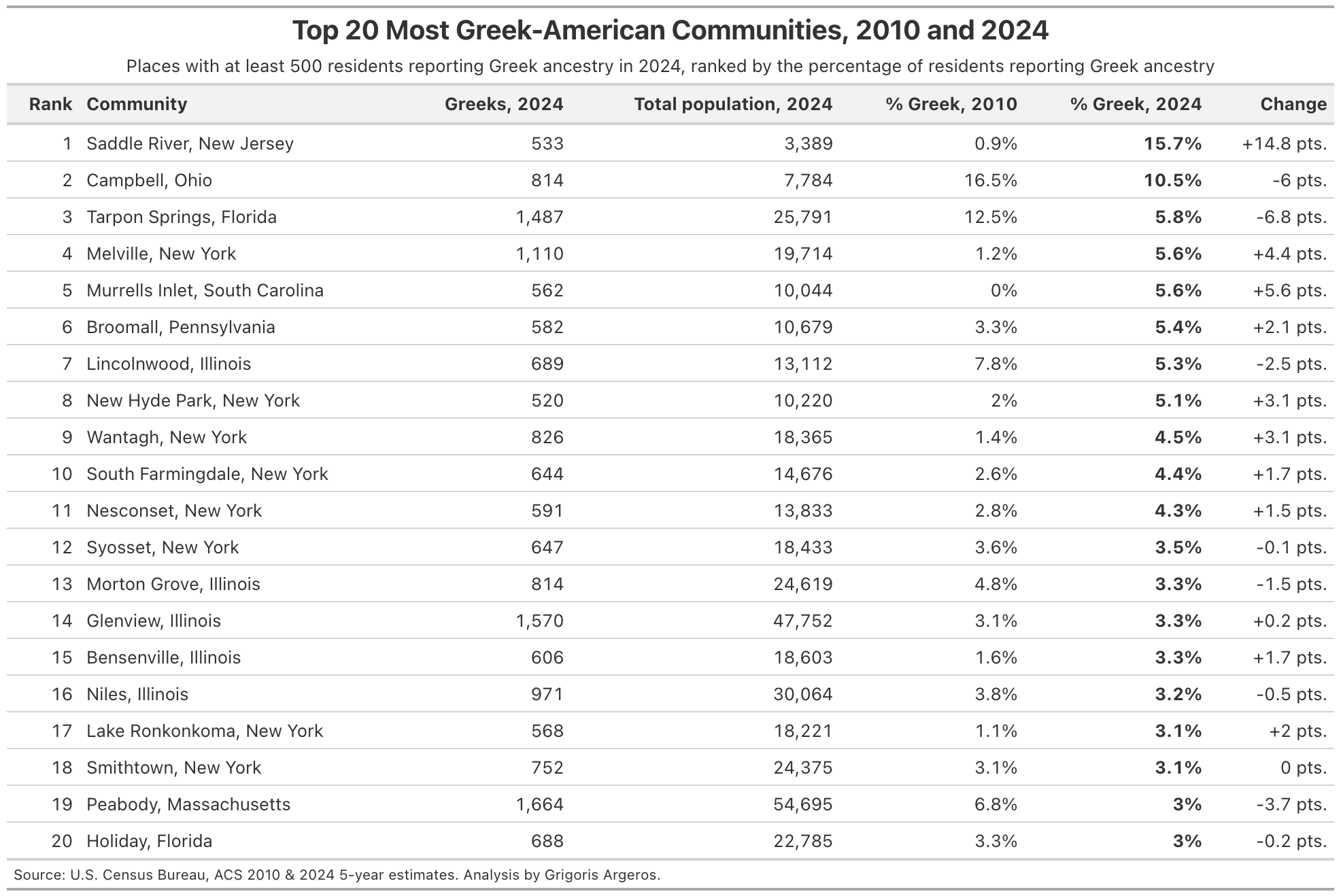
Table 1 showing the top 20 U.S. communities with the highest shares of residents reporting Greek ancestry in 2024, based on American Community Survey data. The table includes Greek ancestry population, total population, percentage reporting Greek ancestry in 2010 and 2024, and percentage-point change over time. Saddle River, New Jersey ranks first, followed by Campbell, Ohio and Tarpon Springs, Florida.
Table 1 above provides additional context by comparing the same twenty communities in 2010 and 2024. The results show that the concentration of Greek Americans has changed differently across places over time.
Several communities experienced increases in the share of residents reporting Greek ancestry. Saddle River, New Jersey, recorded the largest increase, rising from 0.9% in 2010 to 15.7% in 2024, an increase of 14.8 percentage points. Other notable increases occurred in Murrells Inlet, South Carolina (+5.6 percentage points), Melville, New York (+4.4 points), New Hyde Park, New York (+3.1 points), and Wantagh, New York (+3.1 points).
At the same time, several communities experienced declines. Tarpon Springs, Florida, declined from 12.5% in 2010 to 5.8% in 2024, a 6.8 percentage point decline, while Campbell, Ohio, declined from 16.5% to 10.5%, a 6 percentage point decline. Smaller declines were observed in Lincolnwood, Illinois; Morton Grove, Illinois; Peabody, Massachusetts; Niles, Illinois; and Holiday, Florida.
The table also highlights the difference between concentration and population size. Saddle River ranked first in 2024 because residents reporting Greek ancestry made up a large share of its population, even though the estimated Greek ancestry population was 533. Meanwhile, places such as Peabody, Massachusetts; Tarpon Springs, Florida; and Glenview, Illinois had larger Greek ancestry populations but ranked lower because Greek Americans represented a smaller share of each place’s total population.
Overall, the results show that the places with the largest Greek-American populations are not necessarily those with the highest concentrations of Greek Americans. While several long-established Greek-American communities remain among the most concentrated in the country, other communities have increased in prominence over time. Together, these findings provide an additional perspective on where Greek Americans live in the United States.