Summary
Table 1 and Figure 1 together show two key developments between 2006–2010 and 2020–2024:
The number of people reporting Greek ancestry decreased slightly.
More people began reporting Greek alongside other ancestries rather than reporting Greek only.
The largest change was the 24.5 percent decline in Greek-only reporting.
At the same time, reporting Greek in combination with another ancestry has increased and now represents the majority of the Greek ancestry population.
The data show that the change over time reflects not only a modest population decline, but also a shift in how Greek ancestry is reported. A growing share of those reporting Greek ancestry do so in combination with another ancestry.
Overall, the data document both a modest decline in the total number of people reporting Greek ancestry and a noticeable change in how that ancestry is reported.
Detailed Findings
The size of the Greek-American population depends on how we define “Greek.” The American Community Survey (ACS) asks people to report their ancestry, and respondents may list up to two ancestries. Because of this, Greek ancestry can be counted in three different ways.
As shown in Table 1 and illustrated in Figure 1, these three categories are:
Greek Only – People who reported only Greek ancestry.
Greek + Another Ancestry – People who reported Greek along with at least one other ancestry.
Any Greek Ancestry – Everyone who reported Greek, whether alone or in combination with another ancestry.
The choice of definition affects how large the Greek-American population appears.
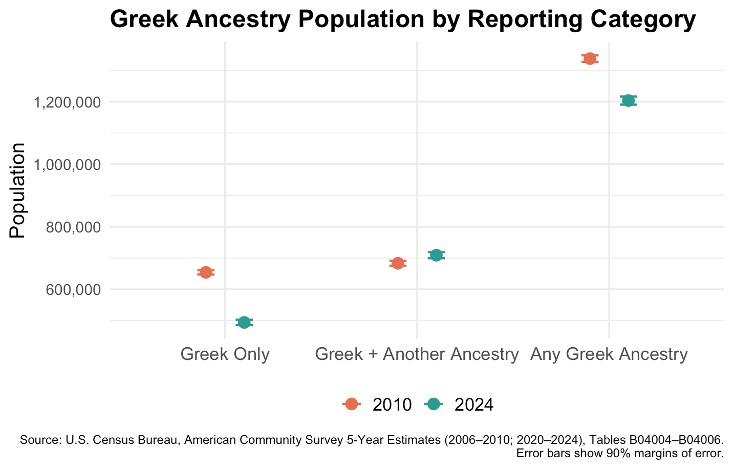
Figure 1
Population Size by Reporting Category
2006–2010
In the 2006–2010 ACS five-year estimates:
Greek Only: 654,228 (48.9%)
Greek + Another Ancestry: 683,348 (51.1%)
Any Greek Ancestry: 1,337,511
During this time, the Greek ancestry population was almost evenly divided. About 49 percent reported Greek only, while 51 percent reported Greek along with another ancestry. In other words, single-ancestry and multiple-ancestry reporting were nearly equal.
You can see this balance clearly in Figure 1, where the orange markers (representing 2010) for “Greek Only” and “Greek + Another Ancestry” are very close in size.
2020–2024
By 2020–2024, the pattern had changed:
Greek Only: 494,222 (41.1%)
Greek + Another Ancestry: 709,134 (58.9%)
Any Greek Ancestry: 1,203,356
Now, the majority of people who report Greek ancestry do so along with another ancestry. Only 41 percent report Greek alone, while nearly 59 percent report Greek plus another ancestry.
This shift is visible in Figure 1, where the green markers (representing 2024) show that “Greek + Another Ancestry” is clearly larger than “Greek Only.”
Changes Over Time
Table 1 shows the numerical and percentage changes between the two time periods.
Decline in Greek Only
Between 2006–2010 and 2020–2024:
The number reporting Greek only declined by 160,006 people.
This represents a decrease of 24.5 percent.
This is the largest change in the table. The drop in Greek-only reporting accounts for most of the overall decline in the total Greek ancestry population.

Table 1
Note: Due to independent estimation and rounding procedures in the American Community Survey, single- and multiple-ancestry estimates may not sum exactly to total ancestry counts.
Increase in Multiple Ancestry Reporting
During the same period:
The number of people reporting Greek along with another ancestry increased by 25,786.
This is a 3.8 percent gain.
Although this increase is modest compared to the decline in Greek-only reporting, it shows a continued shift toward multiple-ancestry identification.
Modest Decline in Total Greek Ancestry
The total number of people reporting any Greek ancestry declined from 1,337,511 to 1,203,356. That is a decrease of 134,155 people, or about 10 percent.
Importantly, this overall decline is smaller than the decline in Greek-only reporting. This means that part of the drop in single-ancestry reporting was offset by growth in multiple-ancestry reporting.
A Shift in Composition
The most important change over time is not just the decline in numbers, but the change in how people report their ancestry.
In 2006–2010:
Greek Only made up 48.9 percent of the total.
Greek + Another made up 51.1 percent.
By 2020–2024:
Greek Only made up 41.1 percent.
Greek + Another made up 58.9 percent.
In short, the Greek ancestry population has shifted from being evenly divided to being mostly of multiple ancestry.
Statistical Reliability
The error bars shown in Figure 1 represent 90% confidence intervals from the ACS. These margins of error are small relative to the differences shown in the table.
Statistical testing indicates that the changes between 2006–2010 and 2020–2024 are statistically significant. The decline in Greek-only reporting, the increase in multiple-ancestry reporting, and the overall decline in total Greek ancestry are all larger than what could be explained by sampling variation alone.
Minor differences between the summed categories and the total are due to independent estimation and rounding procedures in the ACS and are statistically trivial.
Source: U.S. Census Bureau, American Community Survey (ACS), ACS 2006–2010 and 2020–2024 Five-Year Estimates; Tables B04004–B04006.